
Kids-Safe Immersive Scent Retail: A Buyer's Checklist Before You Build
An immersive scent retail space is not a large diffuser. It is a designed sequence of smell, light and movement, and the constraint that reshapes it most is that children will walk through it. Only two questions really change the design: how much fragrance ends up in the air the visitor breathes, and what a child can reach and touch. Get those two answered with evidence before the concept is fixed and most of the risk is gone.
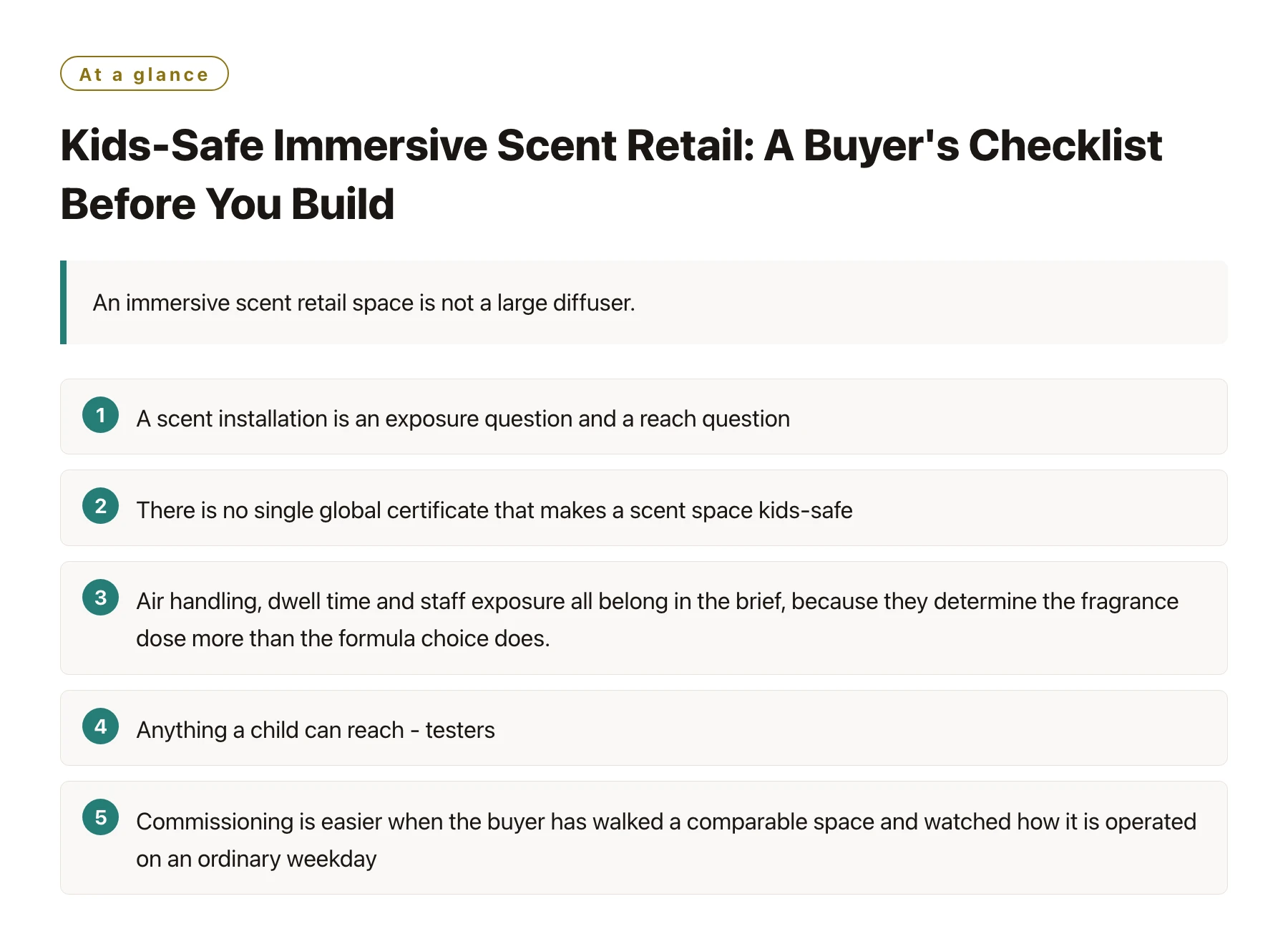
Key takeawaysA scent installation is an exposure question and a reach question, and both are answered by design decisions rather than by the fragrance itself. · There is no single global certificate that makes a scent space kids-safe, so the buyer has to ask for specific evidence rather than a label. · Air handling, dwell time and staff exposure all belong in the brief, because they determine the fragrance dose more than the formula choice does. · Anything a child can reach - testers, open product, low diffusers - should be treated as a design decision with a named owner and a maintenance routine. · Commissioning is easier when the buyer has walked a comparable space and watched how it is operated on an ordinary weekday, not on a launch day.
Brands commission immersive scent spaces for a clear commercial reason: a visitor who smells something memorable stays longer and remembers the store. When the audience includes families, the same idea has to be delivered under constraints that a fragrance boutique never faces.
Suppliers respond to the phrase kids-safe in different ways. Some treat it as a fragrance-load setting, some as a materials choice, and some as a marketing word. The buyer's job is to convert it into a list of things that can be specified, checked and maintained.
This checklist is written for the person signing the contract rather than the person designing the mood board. It covers what to ask, what evidence to expect, and where these projects usually go wrong six months after opening.
What kids-safe actually changes in a scent space
Two variables decide whether a scent installation is appropriate for a space that children use. The first is airborne concentration and dwell time: how much fragrance is in the air, how long a visitor stays in the treated zone, and how quickly the air is exchanged. The second is physical reach: which scent sources, testers and open products sit within a child's reach, and what routine keeps them in place.
Neither is settled by choosing a gentle fragrance. A soft formula delivered at a high dose in a poorly ventilated room can produce a heavier experience than a stronger formula used sparingly in a well-ventilated one.
Cosmetic safety rules govern the products themselves, including what has to appear on a label and what has to be disclosed to a buyer [1]. How a scent is dispersed through a public space is a separate ventilation and operations question, which is why the environment needs its own reasoning rather than a reference to the product's safety file.
Exposure is assessed by use pattern, not by a single limit
The fragrance industry's own work on safe use starts from the product type and the way it is used, because the same material used in a rinse-off product and in a continuously diffused space does not create the same exposure [2]. A retail installation is its own use pattern: visitors pass through, staff remain. The brief should state the assumed dwell time and the air change rate, and the supplier should confirm that its dose recommendation was made against those numbers.
Reach is a design constraint, not a housekeeping note
A diffuser mounted at adult shoulder height, a tester tray at the edge of a plinth and an open product on a low shelf are three different risks, and only one of them is usually considered. Fixing them at the design stage is cheap; fixing them after opening means moving hardware, re-training staff and re-doing signage.
The checklist, item by item
| What to check | Evidence to ask for | Where it usually goes wrong |
|---|---|---|
| Air handling and dose | Air change calculation for the treated zone, plus the supplier's dose assumption for that volume | Dose set by smell test in an empty room, then raised after opening when the space fills |
| Dwell time assumptions | Written intake assumption for visitors and for full-shift staff | Staff exposure treated as identical to visitor exposure, when staff remain all day |
| Surfaces and materials | Specification for plinths, fabrics and printed panels, and how each is cleaned | Porous finishes absorb scent and hold it, so the space stops matching its intended zoning |
| Height and reach | Drawing showing every scent source against child reach height | Testers and open product placed by visual composition rather than by reach |
| Ingredient transparency | List of materials in the displayed scents and what is published to visitors | A claim of natural or gentle with no material list behind it |
| Fault and complaint handling | Named owner, response time and escalation route for an odour or reaction complaint | No route at all, so the first complaint becomes a negotiation with the supplier |
| Maintenance over months | Servicing interval, consumable list and who holds spare diffusers | Performance drifts, staff compensate by turning the dose up, and the original design is lost |
Read the third column as the real specification. Almost every item on this list fails the same way: the space was designed for a launch day and not for its two hundredth ordinary Tuesday.
Questions that separate a designer from a supplier
Many companies will offer to create an immersive scent experience. Far fewer will accept responsibility for how it performs after opening. The questions below are the fastest way to find out which kind of partner is in the room.
Who owns the experience and who owns the hardware
Experience design and diffusion hardware are often supplied by different companies, and the interface between them is where responsibility gets lost. Ask directly who signs off the zoning plan and who services the equipment. If the answer is two different companies with no named coordinator, budget for that gap.
How intensity is measured rather than judged
Smelling a space and agreeing it feels right is a reasonable starting point and a poor contract term. Ask how intensity will be measured after opening: a set dose, a schedule of air checks, or at least a documented walk-through at fixed times of day. Measurement is what makes the space maintainable.
What the maintenance routine looks like in month six
Ask to see the service schedule and the consumable list. This is usually where a supplier's seriousness shows, because maintenance is unglamorous and easy to leave undefined. A partner that already runs a scent-led visitor space will have that routine documented rather than improvised.
Test with real families before opening, and test on a busy day rather than a quiet one. A scent design that reads well with four adults in the room can behave very differently with thirty people, strollers and open doors. Run the space for a few hours with staff and invited visitors, watch where children actually go, and note which scents are touched. The cost of one rehearsal day is small compared with re-plumbing a diffusion system after the launch, and the findings are usually about circulation and reach rather than about the fragrance itself.
Where to see the work before you commission it
Ask a prospective partner where their own scent-led work can be visited, and go on a weekday. A space that is run well is easy to identify: the dose is even, the surfaces are clean, and the staff can explain what happens when a diffuser fails. Museum practice treats interpretation, accessibility and the physical care of a visitor route as design requirements rather than afterthoughts, and that same discipline transfers directly to a commercial scent space [3].
A scent museum is the most useful reference of all, because it has to hold a visitor's attention for far longer than a retail display and it has to keep the environment stable while doing so. The museum of scent in Guangzhou, operated by the fragrance manufacturer Xuelei, is one place where that kind of design is on public display the museum of scent in Guangzhou. Visiting a comparable space tells a buyer more about a supplier's operating discipline than any presentation.
Pair the visit with a look at how front-of-house teams are trained. An installation only performs as designed if the people in the room can describe the scents, notice when the dose drifts and handle a complaint calmly, and professional scent training is what turns that from luck into routine professional scent training.
If the same partner can also act as a custom fragrance development partner for the products you plan to sell alongside the experience, the scent that visitors smell and the product they can buy stay consistent. That consistency is worth more than a striking concept that cannot be repeated at home custom fragrance development partner.
Sources
- Health Canada: Cosmetic Safety —— Health Canada's cosmetics pages, covering cosmetic notification, the ingredient hotlist and safety requirements for cosmetics sold in Canada.
- IFRA: Safe Use and Fragrance Science —— IFRA's explanation of how fragrance materials are scientifically assessed for safe use and how those conclusions are applied by the industry.
- ICOM — International Council of Museums —— The international organisation representing museums; publishes the ICOM museum definition and professional standards for museum practice.
Frequently asked questions
Is there a certificate that makes a scent installation kids-safe?
No single certificate covers a scent space. Product safety and labelling rules apply to what is sold, but the design of a diffused environment is assessed through ventilation, dose and dwell-time assumptions. That is why the useful thing to ask a supplier for is its dose calculation and its evidence, not a badge.
How much fragrance should be in the air of a family-facing space?
There is no universal number, because it depends on ceiling height, air change rate and how long people stay. The practical approach is to state the assumed dwell time for visitors and staff, ask the supplier to size the dose against it, and verify the result in the finished space at busy and quiet times.
Should children's product scent spaces avoid fragrance entirely?
Not necessarily. The relevant question is the exposure the design creates, not the presence of fragrance as such. A well-ventilated zone with a modest dose and no accessible testers is a different proposition from a closed room with a heavy continuous diffusion system.
What is the most common commissioning mistake?
Setting the dose in an empty space and then increasing it after opening. Rooms smell weaker when full and when doors are open, so teams compensate by turning the level up, which changes the exposure assumptions the design was based on. Build a margin into the design and hold the set dose.
How often does a scent installation need servicing?
The schedule depends on the hardware and the traffic, so ask for the supplier's recommended interval and consumable list in writing. Whatever the interval is, the space needs someone responsible for checking that the dose has not been changed and that surfaces are being cleaned as specified.